Abstract
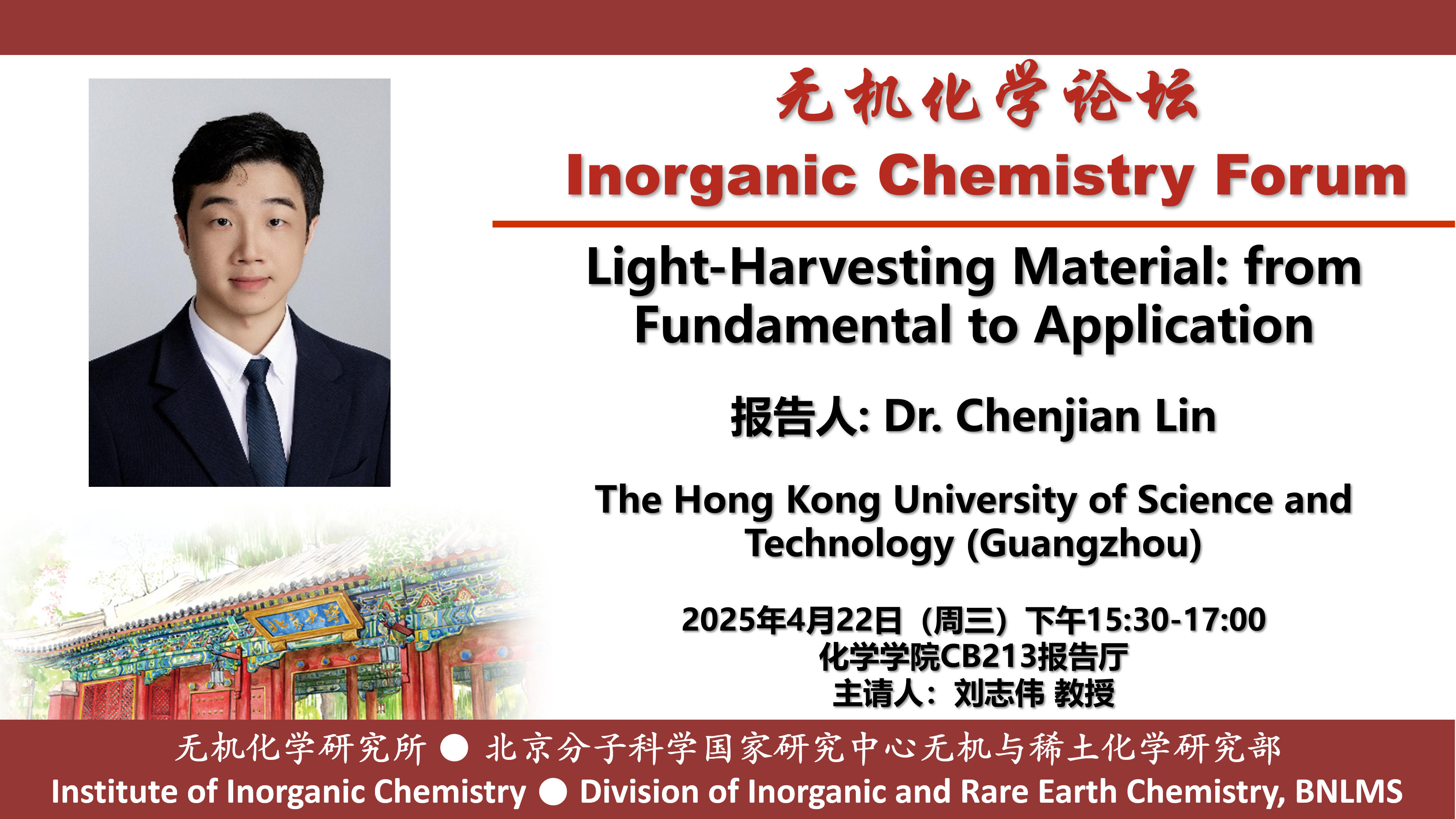
Among all sustainable energy sources, solar energy stands out as the most abundant and accessible. Harnessing this immense resource efficiently and economically is therefore central to achieving a green energy future. The efficient capture and conversion of solar energy into electricity remain central challenges in the pursuit of sustainable energy technologies. Achieving these goals requires not only a molecular-level understanding of how light-induced charge and energy processes are governed by the structure and interactions of complex materials, but also advanced characterization methods to reveal the structure–property relationships that guide the design of next-generation materials. Bridging the gap between synthetic chemistry, photophysics, and structural engineering, Dr. Chenjian Lin’s research aims to uncover the fundamental design principles that link molecular order to optoelectronic function.
Dr. Lin focused on elucidating how molecular structure and electronic coupling dictate excited-state charge and energy dynamics in molecular model systems. He combined targeted molecular synthesis and crystal engineering with ultrafast spectroscopy to probe structure–property relationships in organic chromophore assemblies. His studies revealed that vibronically coherent intermediates can accelerate symmetry-breaking charge transfer,1, 3 that efficient singlet fission arises from slip-stacked crystal packing,4 and that ultrafast charge transfer can be engineered in donor–acceptor–acceptor molecular frameworks.5
Building on these mechanistic insights, Dr. Lin’s research extends molecular packing control to hybrid two-dimensional metal-halide perovskites.6 By designing intralayer bidentate ligands that act as molecular clamps, he developed a new class of structurally robust 2D perovskites with enhanced thermal stability.2 These new designs have been successfully implemented in photovoltaic devices, demonstrating improved efficiency and operational stability. Collectively, his research establishes design principles that connect molecular order, hybrid structural engineering, and device-level performance, providing a coherent framework for the rational development of next-generation light-harvesting materials.
Biography
Dr. Chenjian Lin received his B.S. in Materials Chemistry at Peking University in 2018 and conducted undergraduate research with Prof. Chunhui Huang on lanthanide photophysics and organic optoelectronic materials. He then pursued his Ph.D. in Chemistry at Northwestern University in the U.S., under the supervision of Prof. Michael R. Wasielewski, focusing on excited-state charge and energy dynamics in molecular chromophore assemblies using ultrafast spectroscopy, and earned his degree in 2022. Since 2023, Dr. Lin had been a postdoctoral fellow with Prof. Letian Dou, first at Purdue University and later at Emory University following the group’s relocation, working on designing stable two-dimensional perovskites. In 2026, he entered the Hong Kong University of Science and Technology (Guangzhou) as an assistant professor. His current research integrates molecular design and structural engineering to develop stable and efficient light-harvesting materials and applications.
References:
(1) Lin, C.†; Kim, T.†; Schultz, J.D.; Young, R.M.; Wasielewski, M.R. Accelerating symmetry-breaking charge separation in a perylenediimide trimer through a vibronically coherent dimer intermediate Nat. Chem. 2022, 14, 786-793. (†Contributed equally to this work)
(2) Lin, C.†; Tang, Y.†; Nian, Z.†; Coffey, A.H.; Wang, Y.; Yang, H.; Wu, P.; Yang, Y.-T.; Joy, Syed.; Graham, K.R.; Xu, W.; Zhu, C.; Savoie, B.M.; Dou, L. Intralayer Bidentate Diammoniums for Stable Two-Dimensional Perovskites Nat. Chem. 2026, 18, 275-282 (†Contributed equally to this work)
(3) Kim, T.†; Lin, C.†; Schultz, J.D.; Young, R.M.; Wasielewski, M.R. π-Stacking-Dependent Vibronic Couplings Drive Excited-State Dynamics in Perylenediimide Assemblies J. Am. Chem. Soc. 2022, 144, 11386-11396. (†Contributed equally to this work)
(4) Lin, C.; Yue, Q.; Brown, P.J.; Williams, M.L.; Palmer, J.R.; Myong, M.; Zhao, X.; Young, R.M.; Wasielewski, M.R. Singlet Fission in Perylene Monoimide Single Crystals and Polycrystalline Films J. Phys. Chem. Lett. 2023, 14, 2573-2579.
(5) Lin, C.†; O’Connor, J.P.†; Phelan, B.T.; Young, R.M.; Wasielewski, M.R. Ultrafast Charge Transfer Dynamics in a Slip-stacked Donor-Acceptor-Acceptor System J. Phys. Chem. A 2024, 128, 244-250 (†Contributed equally to this work)
(6) Lin, C.; Tang, Y.; Xu, W.; Kumar, P.; Dou, L. Charge Transfer in 2D Halide Perovskites and 2D/3D Heterostructures ACS Energy Lett. 2024, 9, 3877-3886 (Perspective paper)



 北大化学微信