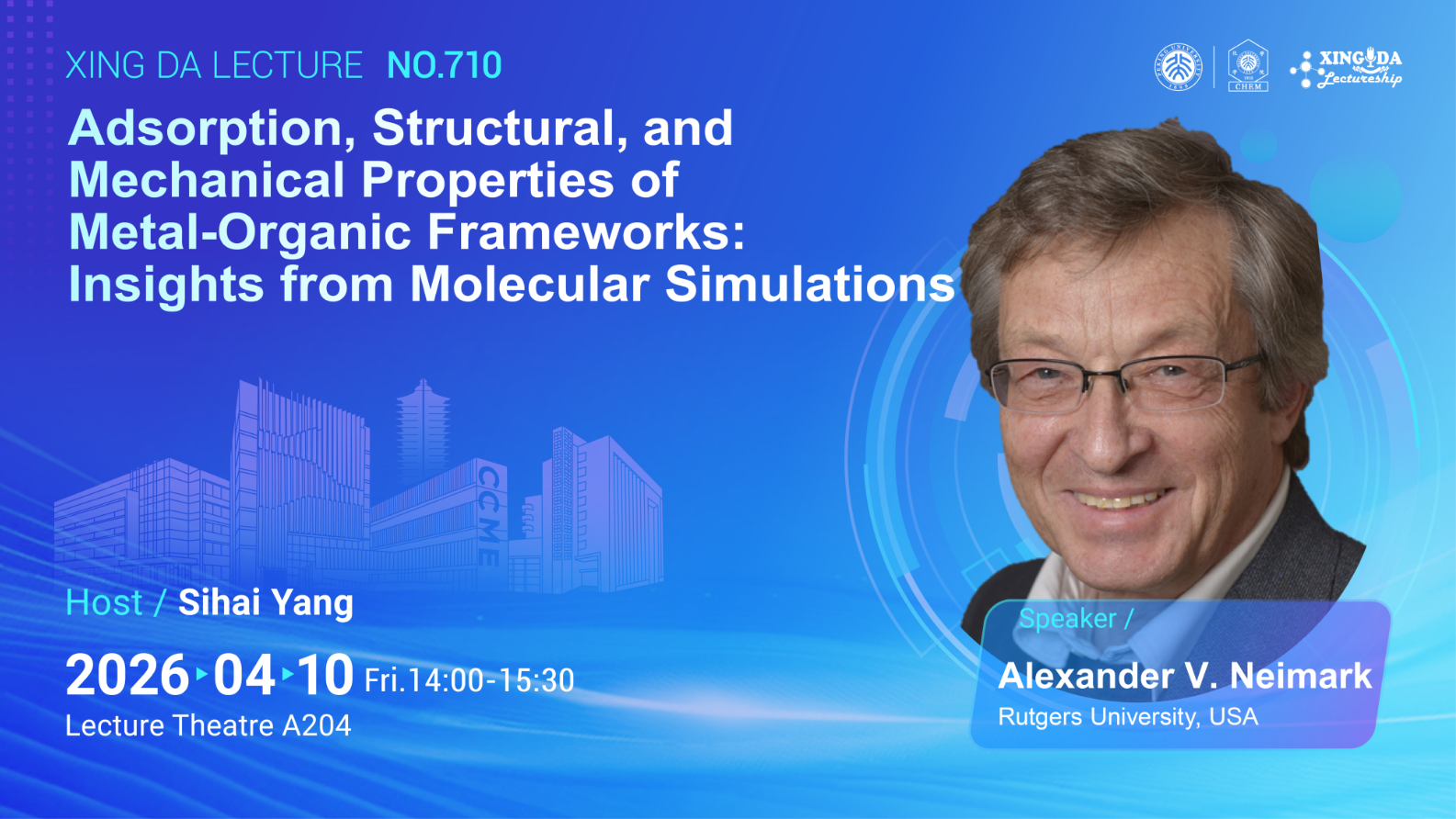
Abstract
Recent Nobel prize recognizing the inventors of Metal-Organic Frameworks (MOF) has sparked renewed overarching interest in these fascinating materials. Built of metal complexes connected by organic linkers into three-dimensional porous crystals, MOFs can selectively adsorb, separate, release, transport or block various chemical and biological species. Their intrinsic framework flexibility enables the design of compliant molecular sieves, membranes, sensors, and actuators. The unique engineering properties of MOFs arise from the interplay of the chemistry of their building units and the morphology of their pore structure, both of which can be tailored for particular applications. Gaining a fundamental understanding of the physical mechanisms that couple adsorption, structural response, and mechanical behavior is essential for advancing the design, fabrication, quality control, and practical deployment of MOF-based materials. In this lecture, I will illustrate, through several examples from our recent research, how the advanced statistical mechanics and molecular simulation methods help elucidate the fundamental structure-property relationships and provide important practical insights of direct relevance to MOF materials engineering.
Literature
Dantas and Neimark, Coupling Structural and Adsorption Properties of Metal-Organic Frameworks: From Pore Size Distribution to Pore Type Distribution, ACS Appl. Mater. & Interfaces, 2020, 12, 15595.
Parashar, Zhu, Dantas, and Neimark, Compartmentalization of Adsorption Isotherms Reveals the Specifics of Guest-Host Interactions. ACS Appl. Nano Mater.,2021, 4, 5531.
Parashar and Neimark, Pore Structure Compartmentalization for Advanced Characterization of Metal-Organic Framework Materials. J. of Chemical Information and Modeling, 2024, 64; 3260.
Parashar and Neimark, Understanding the Origins of Reversible and Hysteretic Pathways of Adsorption Phase Transitions in Metal-Organic Frameworks, JCIS, 2024, 673, 700.
Parashar, Corrente, and Neimark, Unveiling Non-Monotonic Deformation of Flexible MOFs during Gas Adsorption: From Contraction and Softening to Expansion and Hardening, JCIS, 2025, 606, 88.
Neimark, Corrente, and Coudert, Phase Transformations in MOFs Induced by Adsorbate Exchange. Langmuir, 2025, 41, 4720.
Biography
Dr. Alexander V. Neimark is a Distinguished Professor of Chemical and Biochemical Engineering at Rutgers University. He graduated and got his MS and DSc degrees from the Moscow State University. His research interests include thermodynamics, statistical mechanics, and molecular modeling of adsorption, transport, and interfacial phenomena in nanoporous and nanostructured materials and self-assembly in surfactant and polymeric soft matter systems. He is a recipient of many national and international awards and honored appointments, including Guggenheim Fellow, Blaise Pascal International Chair, Humboldt Fellow, Fellow of American Institute of Chemical Engineers, Fellow of International Adsorption Society, Distinguished Visiting Fellow of the Royal Academy of Engineering, and Leverhulme Professorship. Dr. Neimark published 300+ research papers with 51,000+ citations and the citation index h=81, including the monograph “Dissipative Particle Dynamics: Fundamentals and Applications in Soft Matter Science and Engineering”, Elsevier, 2025.



 北大化学微信